- Home
- Community
- Maps & Other Resources
- Other Government Links
- Botanical Survey
- J - Rare Plant Species
J - Rare Plant Species
The Pennsylvania Natural Diversity Inventory (PNDI) keeps track of all species in the state determined to be of special concern. Endangered species (PE) are those in danger of becoming extinct in the state. Threatened species (PT) may become endangered if their habitats and populations are not maintained at current levels, while Rare species (PR) are uncommon or restricted in range or numbers. Undetermined species (PU) are believed to be in danger of population decline but currently not enough is known of their range or population dynamics to categorize them as endangered, threatened, or rare. Vulnerable (PV) species are being actively gathered by commercial collectors, while extirpated species (PX) are believed to be extinct in the state. Special population (SP) includes watchlist species for which more information is wanted, species that indicate special habitats, species that host uncommon insects, and species with a restricted distribution in PA.
One Endangered, seven Threatened, two Rare, and one Undetermined species of special concern were found during the survey as shown on the following chart, where "*" indicates that at least one population for that species was known before 2010. Only one of the species was seen at more than one site, and four of them were seen only at the airport. General locations of rare plant species are shown on Maps 3 and 4.
| Scientific Name | Common Name | Number of Sites | State Status | Habitat |
|---|---|---|---|---|
| Smooth swallow-wort | 1 | PE | Fields | |
| Short-awned foxtail | 1 | PT | Moist fields | |
| Long’s sedge | 1 | PT | Moist fields | |
| Fringe tree | 1 | PT | Woods | |
| St. Andrew’s-cross | 1 | PT | Dry ground | |
| Grass-leaved rush | 1 | PT | Wetland | |
| Nodding trillium | 1 | PT | Woods | |
| Netted chain-fern | 1 | PT | Wetland | |
| Elliott’s beard-grass | 3 | PR | Open | |
Bolboschoenus fluviatilis | River bulrush | 1 | PR | Marshes |
| Desmodium nuttallii | Nuttall’s tick-trefoil | 1 | PU | Dry fields |
In addition, ten Special Population species were observed in the Township; again.
| Scientific Name | Common Name | No. of Sites | Habitat |
|---|---|---|---|
| Wild leeks | 6* | Woodland | |
| A sedge | 5 | Moist edge | |
| A sedge | 1 | Wetland | |
| A sedge | 4 | Open | |
| A sedge | 3* | Woodland | |
| A sedge | 12 | Woodland | |
| Umbrella sedge | 1* | Open | |
| Small white morning-glory | 3 | Open | |
| Butternut | 2 | Woodland | |
| Nuttallanthus canadensis | Old-field toadflax | 3* | Open |
Of all twenty-one species, six are found in woodlands, four are wetland species, and eleven are found in fields, meadows, or other open ground dominated by herbaceous plants. They are mostly widespread species that are not rare throughout their range but are at the edge of their range or in a habitat that is disappearing in Pennsylvania. Following are brief descriptions of each species and their habitats:
Allium Tricoccum (Wild Leeks or Ramps) - Special Population
Wild leek is becoming more common in rich woods in southern Chester County, partly because it is not bothered by deer. Locally abundant in rich woodlands and wooded slopes, especially on gneiss, it is not of special concern in Chester County.
Alopecurus Aequalis (Short-Awned Foxtail) - Threatened, Northern
Short-awned foxtail is a wide-ranging grass that is usually found in disturbed habitats in southeastern Pennsylvania, making it more of a curiosity than an indicator of high-quality habitat. The New Garden site is an abandoned storage area.
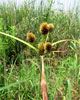 Andropogon Gyrations (Elliott's Beard-Grass) - Rare, Southern
Elliott's beard grass grows on infrequently mown, dry upland meadows and banks, usually found with (but almost always less common) than its close relative broomsedge (Andropogon virginicus). Three small populations were observed in the Township. One of the populations, at the New Garden Airport, was quite large in 2006 but had been reduced to a few plants in 2010. In Pennsylvania, it is only found in the southeast and is vulnerable to natural succession and loss of habitat.
Bolboschoenus Fluviatilis (River Bulrush) - Rare
A small patch of this rhizomatous sedge growing on the inbound delta mouth of Somerset Lake did not flower, so the identification was not confirmed. In this area, it is more commonly found as a fresh-water tidal species. There are no associates that indicate that it was intentionally planted, so it may have been brought in by waterfowl.
Carex Conjunctiva (a Sedge) - Special Population
This sedge usually grows in small populations on moist roadsides and disturbed ground including pastures, and is underreported rather than uncommon. It was seen five times in this survey.
Carex Interior (a Sedge) - Special Population
A small population of Carex interior was found at the edge of the large pond at Broad Run Ridge. It has also been found in the London Tract marsh in White Clay Creek Preserve - also on Cockeysville Marble - so these two populations are probably related.
Carex Longii (Long's Sedge) - Threatened
Long's sedge was found in a moist meadow near the railroad on Cockeysville marble. Although it is uncommon or under-reported, it thrives in disturbed areas further south.
Carex Molesta (a Sedge) - Special Population
Four populations of Carex molesta, a sedge of fields, edges, and ditches, were seen in the Township.
Carex Nigromarginata (a Sedge) - Special Population
Carex nigromarginata is a low-growing sedge of dry woods and edges that was seen three times in the Township.
Carex Striatula (a Sedge) - Special Population
This sedge of rich woods and wooded slopes is frequent in Chester County, and really should not be of special concern.
Chionanthus Virginicus (Fringe Tree) - Threatened
Fringe tree is sometimes planted as an ornamental, but the population at the edge of White Clay Creek is in a typical habitat and is almost certainly native. Another small population along Laurel Woods Lane further south also seems native.
Cynanchum Leave (Smooth Swallow-Wort) - Endangered, Southern
Smooth swallow-wort can occur as an agricultural weed, in which case it is not considered a rare plant. The population near the railroad is in a relatively diverse but mowed field, making its status questionable.
 Cyperus Echinatus (Umbrella Sedge) - Special Population
Umbrella sedge is usually found in dry disturbed exposed habitats such as roadbanks or old upland fields that are frequently mown.
Desmodium Nuttallii (Nuttall's Tick-Trefoil) - Undetermined
A vigorous population of Nuttall's tick-trefoil is growing on the steep bank above the airport entrance road. Many tick-trefoils are disappearing in PA because of loss of habitat, and Nuttall's tick-trefoil will probably be listed as threatened or endangered in the very near future.
Hypericum Stragulum (Saint Andrew's-Cross) - Threatened
Saint Andrew's-cross is a low-growing wiry shrub of open dry soils. The small patch at the airport has persisted in the middle of a dry Andropogon-dominated hay field, and would probably die out if not mowed periodically. This colony is unusual in that it is the only known site for this plant between North Valley Hill, in central Chester County, and the state line, and was not known to occur here until discovered in 2007.
Ipomoea Lacunosa (Small White Morning Glory) - Special Population, Southern
This morning glory is not of concern unless it is growing in a native habitat. In southeastern Pennsylvania, it occurs only as a weed at the edges of cornfields or highly disturbed bare ground. It was seen three times in the Township.
Juglans Cinerea (Butternut) - Special Population
A tree of rich low or floodplain woods, rarely present in any sizable quantity but sometimes overlooked due to a superficial resemblance to its much more common relative black walnut. Several trees were seen near Bucktoe Creek and along White Clay Creek. It is of concern because it is threatened throughout its range by a canker disease.
Juncus Biflorus (Grass-Leaved Rush) - Threatened
A large population of grass-leaved rush is growing in a wet meadow at the airport. This species is more often found closer to the Delaware River, and this location is the farthest west found on a township survey.
Nuttallanthus Canadensis (Old-Field Toadflax) - Special Population
A small perennial herb with spikes of small but showy bluish flowers, this plant prefers sandy dry sunny soil with little competition. It was growing in several places along the railroad in cinders and dry open soil.
Trillium Cernuum V. Cernuum (Nodding Trillium) - Threatened
This woodland herb favors moist rich woods, frequently growing on the upper edges of floodplains or in lower slopes of woodlands. Once considered frequent, it is a species of concern because of deer predation, and the only population observed in the Township was small with mostly non-flowering plants in deer-infested woods. There are or were several populations just east of the Township boundary, and there are likely some more occurrences in New Garden Township.
Woodwardia Areolata (Netted Chain Fern) - Threatened
A small but healthy population of this acidic wetland specialist, first seen several years ago, grows at the edge of a rocky seep near a tributary of Bucktoe Creek.